Inbound SDR

B2B inbound marketing, SEO and AI search.

We build and run the website, local search, daily content and social presence your buyers check before they call. For any B2B company that wants to be found: as its own source of inbound leads, or behind an outbound program.

Company-wide figures across all Abstrakt programs, as of October 2026. The photo shows an Abstrakt rep on a headset call on our St. Louis sales floor.

Ask Ava anything about Abstrakt Sales, out loud or by typing.

The problems we solve

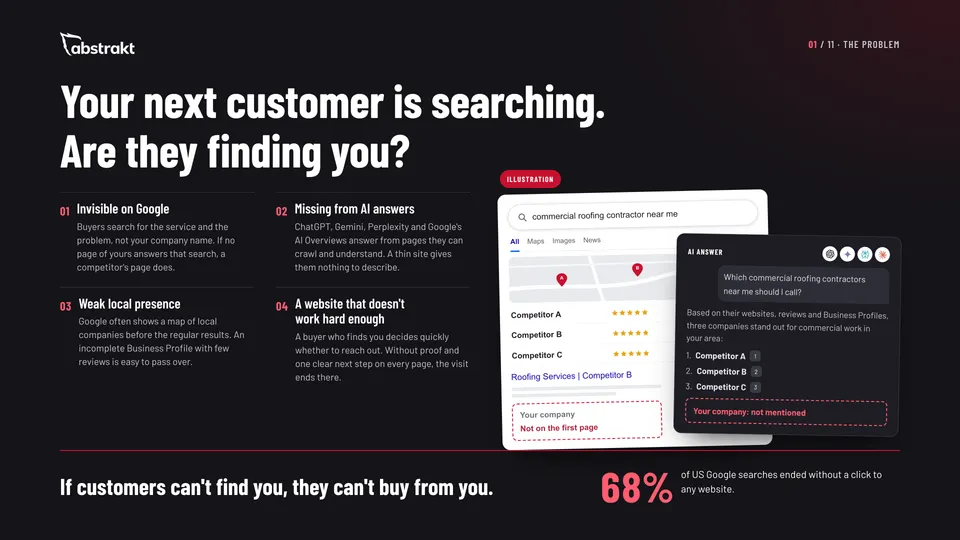
Your next customer is searching. Are they finding you?

Buyers check you out online before they reach out or agree to a meeting. These are the four places a company loses them, and the part of the program that fixes each one.

  1. Invisible on Google

    Buyers search for the service and the problem, not your company name. If no page of yours answers that search, a competitor's page does.

    Solved byA new blog every business day, and a guide for every product or service

  2. Missing from AI answers

    ChatGPT, Gemini, Perplexity and Google's AI Overviews answer from pages they can crawl and understand. A thin site gives them nothing to describe.

    Solved byCrawlable pages, structured data and the AI search crawlers allowed

  3. Weak local presence

    Google often shows a map of local companies before the regular results. An incomplete Business Profile with few reviews is easy to pass over.

    Solved byLocal SEO and your Google Business Profile

  4. A website that doesn't work hard enough

    A buyer who finds you decides quickly whether to reach out. Without proof and one clear next step on every page, the visit ends there.

    Solved byA website built to sell, up to 100 pages

  • 45%of B2B buyers said they used generative AI during a recent purchase, mainly to research vendors and products. 69% still preferred to check what the AI told them with a sales rep.
  • 68%of US Google searches ended without a click to any website. When a buyer searches your name, the results page may be all they see.
  • 8% vs 15%Google users clicked a regular result in 8% of visits when an AI summary appeared, against 15% when none did.

Sources: Gartner (opens in a new tab), Survey of 645 B2B buyers, August to September 2025; published May 20, 2026; SparkToro (opens in a new tab), Similarweb US desktop and mobile clickstream, January to April 2026; published June 9, 2026; Pew Research Center (opens in a new tab), Browsing data from 900 US adults, 68,879 searches, March 2025; published July 22, 2025.

Free AI Visibility Check

the Free AI Visibility Check looks at your website, mobile speed, what an AI assistant says when a buyer asks who to call, and whether you come up in a local search. No email needed.

Already running outbound?

Inbound gives every outbound touch something to land on.

Outbound starts the conversation. Daily content keeps your name in front of the buyer between every touch, and your website, search and AI answers back it up when they look you up.

The fuel loop: how the two programs feed each other

Outbound BDRStarts the conversation

  • Calls every working day
  • Short, text-only emails
  • LinkedIn connections
  • Direct mail

Your SDRs share fresh posts, guides and white papers in follow-ups, and call the companies that visit your site.

  1. A new blog every business day Written from the questions your buyers ask Inbound SDR
  2. Posted to LinkedIn and 5 more platforms Inbound SDR
  3. Your new connections see it The buyers your SDRs connect with see your posts in their feed between touches Both
  4. The buyer recognizes you When your SDR calls again, the name is familiar Outbound BDR
  5. They look you up, and we see the visit Your site and AI answers back it up; visitor identification flags the company for your SDR Both
  6. The appointment holds The buyer already knows what you do Both
  7. Not now? They keep seeing you Your posts stay in their feed until the timing is right Inbound SDR
  8. Back to step 3 until they are ready

Inbound SDRGives every touch something to land on

  • Your website, up to 100 pages
  • Local SEO and your Business Profile
  • Visibility in AI search

Six reasons outbound works harder with inbound behind it

  1. Every call creates a searchAfter an SDR calls, emails or connects, buyers look up your company and often your name. What they find decides whether they agree to the appointment.
  2. Your connections see you every dayThe buyers your SDRs connect with on LinkedIn see your posts in their feed between touches, so your name is familiar before the next call.
  3. Your SDRs always have something new to sendFresh posts, a guide for every service and a white paper give reps a reason to follow up that is not "just checking in."
  4. AI assistants get asked to vet youBuyers ask ChatGPT, Gemini or Perplexity about vendors. If you are missing, or a competitor is named, the appointment starts with doubt.
  5. Booked appointments hold on credibilityA thin or outdated website, or no Google Business Profile, gives a prospect a reason to cancel or not show up.
  6. "Not now" buyers keep seeing youProspects who were not ready keep seeing your posts and find you when they search later. If you are not visible then, the outbound effort goes to whoever is.

Run both

+36 guaranteed appointments a year, three a month.

Outbound BDR clients who add Inbound SDR get 36 more guaranteed appointments a year added to their outbound guarantee. Here is the example, at the published starting prices.

Run both for the best chance at a predictable pipeline. How Outbound BDR works

Example: a 60-appointment annual guarantee
ProgramStarting price per monthGuaranteed appointments a yearCost per guaranteed appointment
Outbound BDR$5,00060$1,000
Outbound BDR + Inbound SDR$6,00096$750

Example only, using a 60-appointment annual guarantee. Your guarantee is defined in your agreement. Cost per guaranteed appointment is the starting price for a year divided by the appointments in the example.

What's included

We build the website in the first month. Then something new goes out every business day.

Eight things are in the starting price, on a 12-month term. Scope grows with the size of the site, the number of markets and the content you need.

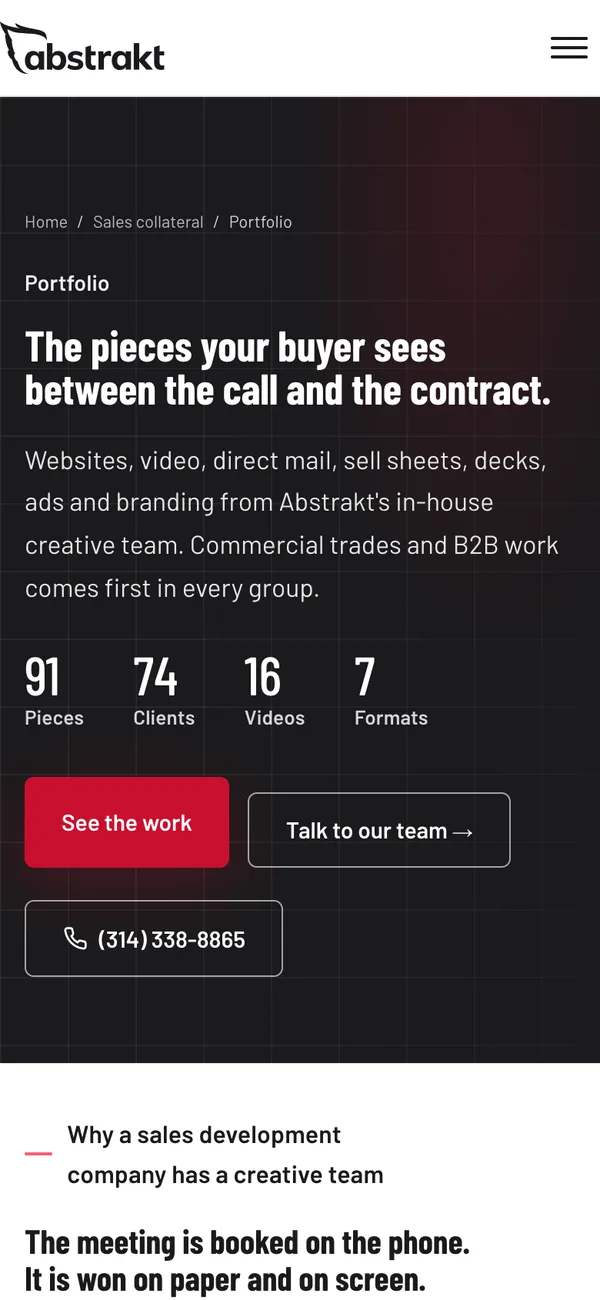
A website built by Abstrakt, shown in a desktop browser The same site laid out for a phone
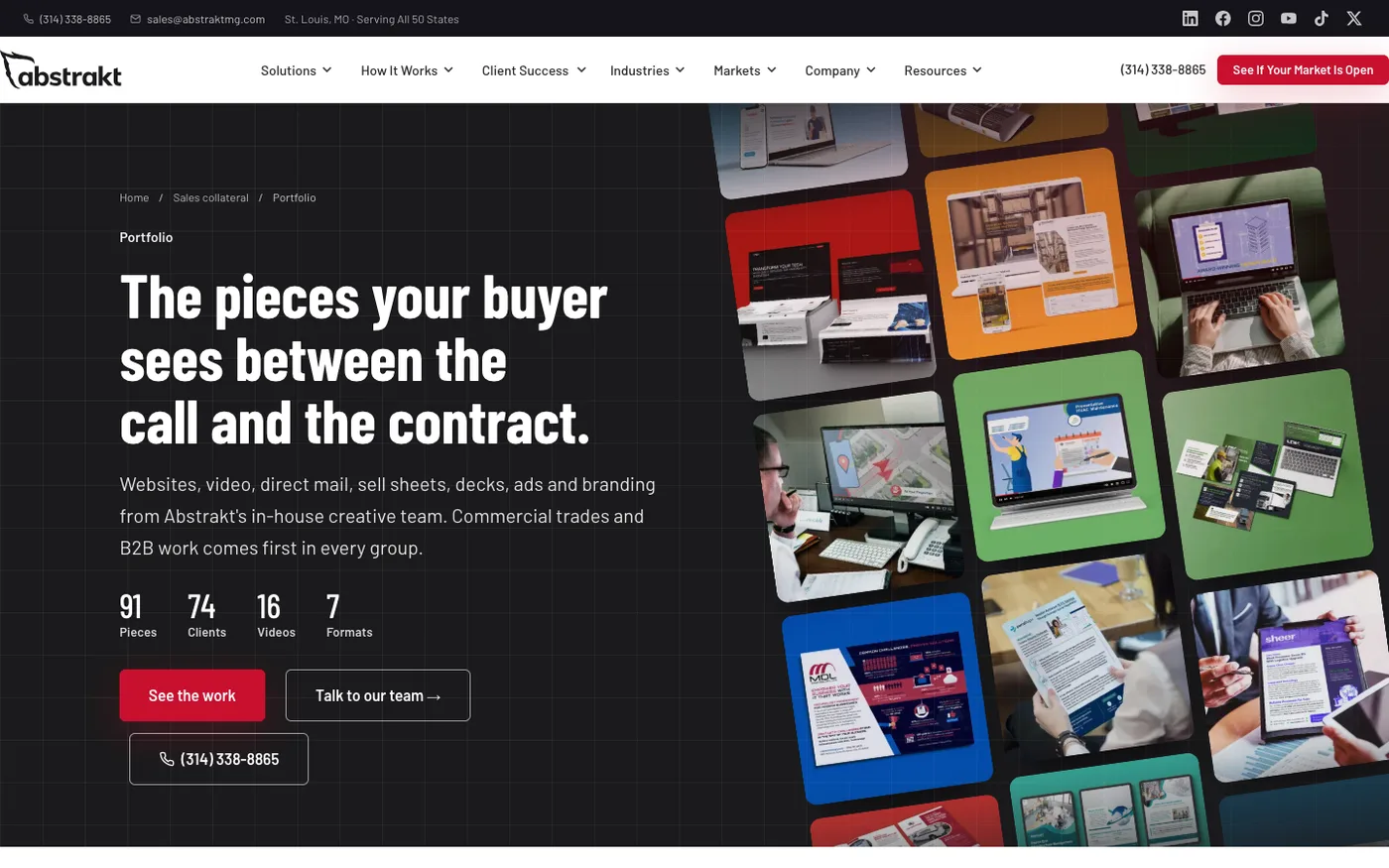
Our portfolio page on abstraktsales.com, built on Astro, the same framework in the program's stack.
  • A website built to sell Built around every service you sell and every area you serve.
  • Local SEO and your Google Business Profile Your Google Business Profile, Bing Places and 65+ directory listings kept accurate through directory submissions and updates, plus local schema and service-area pages, checked every month.
  • A new blog every business day Published on your site and posted through all 6 of your social channels.
  • Every blog posted to 6 social platforms LinkedIn, Facebook, Instagram, TikTok, YouTube and X, so the page a buyer checks shows a company that is busy.
  • 2 to 3 expert hours a month For technical adjustments and fixes, page adjustments, or additional guides and white papers.
  • Monthly reporting and strategist access Monthly reporting, and access to a strategist whenever you have questions.
  • One white paper Written for the buyers your SDRs call, ready to send after a conversation.
  • A guide for every product or service One per service, so every offer has something worth reading and citing.

12-month term. Program expectations and commitments are defined in your agreement. We keep your Google Business Profile accurate through directory submissions and updates; we don't post to it, and we don't manage reviews or reputation.

The detail behind the work

The local SEO checklist we run every month

We run your Google Business Profile, your Bing Places listing, your directory listings and the local pages on your site as one job, every month. When a facility manager searches for your service nearby, or looks you up after a sales call, they find a real, local company worth contacting.

Google Business Profile

  • Verified, with ownership kept in your company's name
  • Primary and secondary categories matched to the services you sell
  • Services, service areas, hours and special hours kept current
  • Photos of real jobs, crews and equipment added through the year
  • A business description written for the buyers you sell to

Listings everywhere else

  • Bing Places for Business set up and optimized
  • Name, address and phone consistent across 65+ directories
  • Duplicate listings found and suppressed
  • Listings monitored so a wrong number or old address gets fixed

Research and local content

  • An audit of your citations, listings and Business Profile for accuracy
  • Competitor rankings, keywords and backlink profiles
  • Geo-specific keywords: your service near the buyer
  • Locally focused content and local link building
  • Directory submissions and updates, so your Business Profile details match everywhere

On your website

  • A service-area page where you have real work and something specific to say
  • Local business schema that matches the name, address and phone on the page
  • The same contact details on the site, the profile and every listing
  • Site speed, mobile layout and Core Web Vitals checked

Tracking

  • Calls, direction requests and website clicks from your profile
  • Form submissions, and calls where call tracking is set up, sent to your CRM for follow-up
  • Monthly reporting on rankings and leads, in the Partner Results Portal

How Google ranks local results, and our part

  • Relevance. Google: How well your Business Profile matches what someone searched. Google asks for complete and detailed business information. Our part: Categories, services, service areas and descriptions matched to the work you sell, plus a page on your site for each service.
  • Distance. Google: How far your business is from the person searching, or from the location Google infers for them. Our part: Nobody can move your shop. We list the areas you actually serve, and build a page for a territory only where you have real work there, so Google knows where you work.
  • Prominence. Google: How well known your business is, including links from other websites and how many reviews you have. Our part: Consistent listings across 65+ directories, local content and local link building that earn mentions and links.

Sources, read October 11, 2026: Google Business Profile Help: Tips to improve your local ranking on Google; Google Business Profile Help: Understand your Business Profile performance and insights; Google Search Central: AI features and your website. The 65+ directories figure is as published by Abstrakt. Our local SEO service.

AI search and technical SEO: what Google and the AI assistants document

Mostly the same things. Google says there are no additional requirements to appear in AI Overviews or AI Mode, and the AI assistants mostly need two things: permission to crawl your site, and a page that answers the question clearly.

What Google says it looks for

  • Helpful, reliable, people-first content. Content written for a clear audience by people with real experience, not pages made to rank. Source
  • Experience, expertise, authority and trust. Google calls trust the most important of the four, and asks who wrote a page, how and why. Source
  • Words people search, in the right places. Titles, main headings, image alt text and link text that use the terms buyers type. Source
  • Crawlable links and a good page experience. Links Google can follow to every page, and pages that work well for the person reading them. Source
  • AI Overviews and AI Mode. The same SEO best practices apply. A page must be indexed and eligible to show with a snippet, structured data should match the visible text, and Business Profile details should be current. Source

What the AI assistants document

  • ChatGPT search. OpenAI's OAI-SearchBot finds pages for ChatGPT search. OpenAI says sites that opt out of OAI-SearchBot will not be shown in ChatGPT search answers. GPTBot, its training crawler, is a separate choice. Source
  • Claude. Anthropic's Claude-SearchBot indexes pages for search, and Claude-User fetches a page when someone asks about it. Anthropic says blocking Claude-SearchBot may reduce your visibility in search results. ClaudeBot, for training, is separate. Source
  • Perplexity. PerplexityBot surfaces and links websites in Perplexity's answers, and Perplexity recommends allowing it in robots.txt. A firewall that blocks it can keep you out. Source
  • Grok. xAI documents tools that let Grok search and browse the web and search X posts, users and threads, returning answers with source citations. Your site and your X presence can both be read. Source

The technical work we do on your site

  • Crawlable HTML. Sites built on Astro ship as plain HTML pages, with internal links to every page and a sitemap.
  • Structured data that matches the page. Organization, local business, service and FAQ schema written from what the page actually says.
  • Clear, direct answers. Every page and guide states its answer first, then explains, so a person or an AI tool gets it in the first lines.
  • One consistent identity. The same company name, address, phone, services and areas on your site, Business Profile, Bing Places, directories and social pages.
  • Fresh, useful content. Daily updates, a guide for every service and a white paper, written for the buyers you want to reach.
  • The right crawlers allowed. We set your robots.txt so search crawlers, including OAI-SearchBot, Claude-SearchBot and PerplexityBot, can reach your pages, and you decide on training crawlers such as GPTBot and ClaudeBot. This site's own robots.txt allows those AI search crawlers by name.

No one can guarantee a ranking or an AI citation, and we do not. What we control is whether your site gives Google and every answer engine a clear, accurate, crawlable reason to show you.

Sources, read October 11, 2026: Google Search Central: Creating helpful, reliable, people-first content; Google Search Central: Google Search Essentials; Google Search Central: AI features and your website; OpenAI: Overview of OpenAI crawlers; Anthropic: Does Anthropic crawl data from the web, and how can site owners block the crawler?; Perplexity: Perplexity crawlers; xAI developer docs: Tools overview and search tools. This site's own robots.txt allows the AI search crawlers by name.

The tech we use and what it costs

The software alone costs more than the program.

These are the tools we run for every Inbound SDR program, at each vendor's published price. You don't license, configure or staff any of them.

$1,427 to $1,708per month for the software on premium plans, one user to two users, before anyone designs a page, writes a blog or manages a listing.

$1,000per month to start Inbound SDR, with the software, the specialists and the daily work included.

The 11 tools in the program

  • AstroOpen source $0
  • SanityGrowth $15
  • GitHubEnterprise $21
  • NetlifyPro $20
  • SemrushAdvanced $549
  • ClaudeMax $100
  • ChatGPTPro $100
  • TavusGrowth $397
  • Google Search ConsoleFree $0
  • ZoomInfoWebsite visitor tracking $200
  • CloudflarePro $25
Plus the people

Specialists who work with AI, on your program.

The roles our digital services list. Each brings a different skill, uses AI for research, outlining and editing, and works across client programs, so you get all of them without hiring one.

  • Digital project managers
  • SEO strategists
  • AI SEO strategists
  • Web designers and developers
  • Copywriters and editors
  • Social media strategists
  • Graphic designers

Claude and ChatGPT for research, outlining and editing support; Semrush for keyword, competitor and AI visibility research.

Plus the time

Every business day, something new goes out.

One every business day. A month has 20 to 23 business days, and every blog goes to all 6 platforms: 120+ posts a month.

No waiting for someone to find the time. Yours goes out every business day.

Illustrative premium configuration, not the minimum cost of building it yourself. List prices with monthly billing from each vendor's public pricing page, read October 11 and October 13, 2026, before tax, for one user; the two-user figure adds a second seat on each per-user plan. Enterprise and other custom-quoted tiers are not added. Usage charges, such as Tavus minutes, are extra. ZoomInfo quotes its prices, so its figure is Abstrakt's quoted cost. Logos are trademarks of their owners; no endorsement implied.

Plan details for each tool

From $417/month on each tool's base paid plan to $1,427/month on the premium plans in our total, before any Enterprise tier, which is priced by quote.

Software stack: what each tool does, its published monthly price range, and the plan and price used in the total for one user
ToolWhat we use it forPublished rangeIn our total
Astro The framework your website is built on: fast, crawlable HTML pages. FreeOpen source $0 $0Open source
Sanity Where your pages, blogs and guides are written, edited and published. $15/moFree $0 · Growth $15 per seat · Enterprise custom $15Growth
GitHub Version control: every change to your site is recorded and can be rolled back. $4 to $21/moFree $0 · Team $4 per user · Enterprise $21 per user $21Enterprise
Netlify Hosting and deployment: each approved update is built and published to your live site. $9 to $20/moFree $0 · Personal $9 · Pro $20 · Enterprise custom $20Pro
Semrush Keyword, competitor and AI visibility research behind every page we plan. $139 to $549/moFree $0 · SEO $139 · Starter $199 · Pro+ $299 · Advanced $549 · Enterprise custom $549Advanced
Claude AI research, outlining and editing support for your pages, blogs and guides. $20 to $125/moFree $0 · Pro $20 · Max $100 · Team (standard seat) $25 per seat · Team (premium seat) $125 per seat · Enterprise custom $100Max
ChatGPT A second AI model for research and drafting support. $8 to $500/moFree $0 · Go $8 · Plus $20 · Pro $100 · Pro (top tier) $500 · Business $25 per user · Enterprise custom $100Pro
Tavus The AI video person who greets visitors and answers questions on your site. $22 to $975/moFree $0 · Starter $22 · Builder $59 · Growth $397 · Business $975 · Enterprise custom $397Growth
Google Search Console Shows how Google finds, indexes and ranks your pages, and which searches bring visitors in. FreeFree $0 $0Free
ZoomInfo Identifies the companies visiting your site so your SDRs can follow up while interest is fresh. $200/moWebsite visitor tracking $200 $200Website visitor tracking
Cloudflare Runs your domain's DNS and protects and speeds up the site in front of your hosting. $25 to $250/moFree $0 · Pro $25 · Business $250 · Enterprise custom $25Pro

Monthly billing list prices read from each vendor's pricing page on October 11, 2026 and October 13, 2026. "Custom" means the vendor quotes the price. Claude Enterprise: $20 per seat plus usage at API rates, billed annually; sales-assisted quotes. ChatGPT Enterprise: Contact sales. Tavus Enterprise: Custom, volume discounts. The two-user figure adds a second seat on each per-user plan and Semrush's additional-user add-on (Netlify Pro covers unlimited members). GitHub shows its prices as the rate for the first 12 months. Vendor prices change; these are as of October 11, 2026 and October 13, 2026.

Proof

Websites we built, and the results they produced

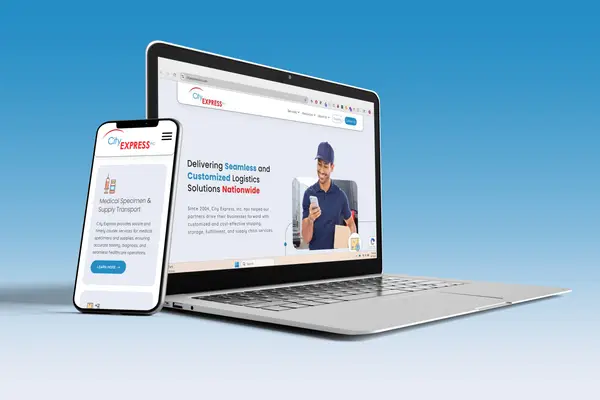
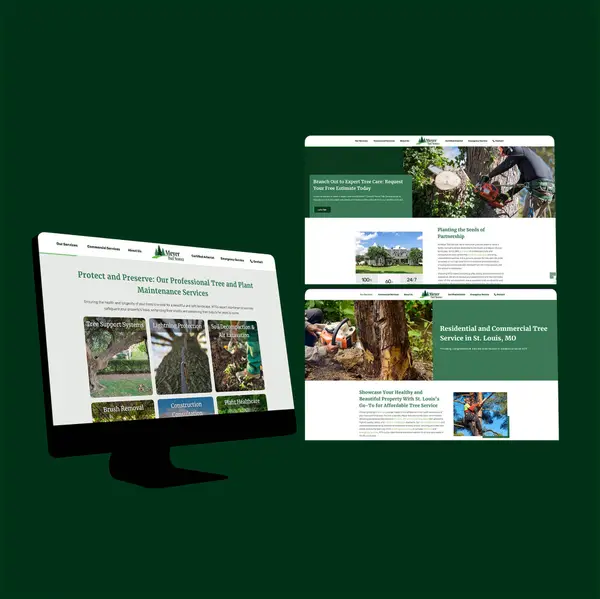
Websites our team built for clients, then four Abstrakt case studies. Each case says what was measured and over what time. Traffic and rankings are not revenue, so we label them apart, and results vary by program.

Websites our team built

Case studies

  • Fire protection

    444 keywords ranked

    Harring Fire Protection, Philadelphia

    What we ran
    A new website and SEO program, run alongside our outbound program. Domain authority of 9 before the new site launched in February 2025. 54,000 monthly impressions within 12 months.
    Measured
    Search visibility and inquiries
    Period
    Site launched February 2025; results 12 months later
    Note
    The $200K in new business on the case page came from outbound and inbound together over 28 months, so it is not counted here as an inbound result.
    Read the case study for Harring Fire Protection
  • Commercial roofing

    590% more organic traffic

    Roofcorp of America, West Coast

    What we ran
    An ongoing SEO program on the company website. Keywords up 1,020%, from 240 to 1,433. Most new inquiries were requests for proposals.
    Measured
    Organic traffic and keywords
    Period
    2020 to March 2023
    Note
    A traffic result. The case study does not report revenue.
    Read the case study for Roofcorp of America
  • Commercial construction

    $1.3 million from two awarded projects

    Northeast commercial construction partner, Northeast

    What we ran
    An SEO program on a website that had never produced a lead. Keywords grew from 112 to 658. 15+ project submissions, 9 estimates and 2 awarded projects from a website that had produced no leads before.
    Measured
    Leads and awarded revenue
    Period
    April 2022 to April 2024
    Note
    Two years in the Inbound SDR program.
    Read the case study for Northeast commercial construction partner
  • Commercial HVAC

    $130,000 deal in 30 days

    Midwest commercial HVAC partner, Midwest

    What we ran
    A long-running SEO program on the company website. 96 keywords on Google's first page by March 2021. The deal closed within 30 days of a long-nurtured prospect re-engaging through the website.
    Measured
    Revenue from one inbound deal
    Period
    Program from 2018; results through 2021
    Note
    The prospect had been in touch for three years before finding the company again through search, so outbound and inbound both played a part.
    Read the case study for Midwest commercial HVAC partner

Get started

Schedule a meeting with an inbound strategist

Tell us where you sell and who you sell to, and a strategist scopes a plan around what your buyers find today. Packages start at $1,000 per month on a 12-month term. Program expectations and commitments are defined in your agreement.

Running outbound? Add Inbound SDR for +36 guaranteed appointments a year. How they work together

  1. 01A visibility reviewYour site, Business Profile, listings, social pages and what AI tools say about you.
  2. 02A practical planThe searches worth winning, the pages and fixes that matter most, and what to measure.
  3. 03Your choice of scopeThe full program, the pieces you are missing, or inbound alongside outbound.

Want a first look on your own? Run the Free AI Visibility Check

Schedule a meeting

Fields marked * are required.

An inbound strategist will contact you to review your current visibility and scope a plan. We use your details only to contact you about it. See our Privacy Policy.

The Inbound SDR presentation

The ten-slide presentation, to read now or share with your team.

Inbound marketing FAQs

What is B2B inbound marketing?

B2B inbound marketing is how a company gets found by business buyers who are already looking: a website that explains the offer, SEO and AI search visibility so the site shows up, content that answers buyer questions, local listings and social pages that make the company look credible. The goal is inquiries from buyers who came to you, not just traffic.

How does inbound marketing generate sales opportunities?

A buyer searches, asks an AI tool or sees a post, lands on a page that answers the question, and takes a next step: a form, a call or a booked meeting. That inquiry is followed up and qualified, by your team or an Abstrakt SDR, and the ones that fit become sales opportunities. Each step is tracked so you can see where opportunities come from.

How do inbound and outbound work together?

Outbound starts conversations with buyers who are not searching yet. Inbound captures buyers who are. Together, a prospect who gets an outbound call and looks you up finds a credible company, and a prospect who read your guide recognizes the name when your SDR calls. We report each channel's leads separately, because how much one helps the other varies by market.

Can inbound marketing work without outbound?

Yes. Inbound SDR is sold on its own. Many companies want an independent source of inbound opportunities: a website, SEO, AI search visibility, content and local search that bring in inquiries for their own team to follow up. Outbound is an option, not a requirement.

What is B2B SEO?

B2B SEO is search engine optimization aimed at business buyers. It means picking the searches your buyers use (services, problems, comparisons, your company name), building one strong page for each intent, and keeping the site technically healthy so Google can crawl and trust it. Search volumes are smaller than in consumer SEO, but each visitor is usually worth more.

How does AI search optimization work?

AI assistants such as ChatGPT search, Perplexity and Google's AI Overviews build answers from web pages they can crawl. AI search optimization, also called AEO or GEO, makes your pages easy for them to read and quote: crawlers allowed, clear entity information, structured data that matches the page, answer-first content and consistent facts across your listings. Google says there are no extra requirements for AI Overviews beyond normal SEO best practices.

How can we improve our visibility in ChatGPT and Google AI search?

Let the search crawlers in (for ChatGPT search, OpenAI's OAI-SearchBot), make sure each service has a page that states plainly what you do, for whom and where, keep your Business Profile and directory listings consistent, and publish useful content with real expertise behind it. Then check how the assistants describe you on the questions that matter. No one can guarantee inclusion in an AI answer, and we do not.

What makes a B2B website convert?

Clarity and proof. The visitor should know within seconds what you do, who it is for and where you work, see evidence from jobs like theirs, and find one obvious next step on every page: a short form, a phone number, a meeting link. Fast load times, a layout that works on a phone and forms that ask only what you need all help.

How do you measure inbound marketing performance?

We separate traffic from leads. Visits, rankings and clicks show visibility. Form submissions, tracked calls and booked meetings are leads. Qualified leads are measured against a definition agreed with you, and revenue is reported when your team records closed deals in the CRM. All of it is in the Partner Results Portal.

How long does SEO take to work?

Initial results can show in 1 to 3 months, noticeable improvement usually comes in 3 to 6 months, and full results take 6 to 12 months or longer, depending on your site's age and authority, your competition and the quality of content. A new site usually starts slower than an established one.

How much does a B2B inbound marketing program cost?

Inbound SDR packages start at $1,000 per month on a 12-month term. Scope depends on the size of the site, the number of markets and how much content you need. Outbound BDR, Inbound SDR and Brand Boost together start at $6,500 per month. Enterprise and multi-location scope is quoted.

What do I get each month?

Every business day we write a blog, publish it on your site and post it through all 6 of your social channels: LinkedIn, Facebook, Instagram, TikTok, YouTube and X. Your Google Business Profile, Bing Places listing and 65+ directory listings are managed through directory submissions and updates and corrected every month. You also get 2 to 3 expert hours a month for technical adjustments and fixes, page adjustments, or additional guides and white papers, monthly reporting, and access to a strategist whenever you have questions.

Do you manage our reviews?

No. Reviews come from your customers and your team, and we do not request, monitor or respond to them. What we manage is the rest of what a buyer sees: your Business Profile details, your listings, your local pages and the content on your site and social channels.

Which industries benefit from B2B inbound marketing?

Companies whose buyers research before they call: commercial trades such as HVAC, roofing, fire protection, construction, electrical, cleaning and landscaping, and B2B companies that sell services to other businesses. Our published inbound results come from fire protection, commercial roofing, commercial construction and commercial HVAC.

How is Inbound SDR different from a marketing firm?

Not in the usual sense. Abstrakt is a technology-enabled sales development company, and Inbound SDR is inbound revenue development: the website, search and content work is measured by the inquiries and qualified leads it produces, and those leads can go straight to an SDR for follow-up.

Do you handle local search for multiple locations?

Yes. We manage each Google Business Profile, keep listings accurate everywhere and build location pages only where you have real work and something specific to say. We never list an address where you do not have an office.

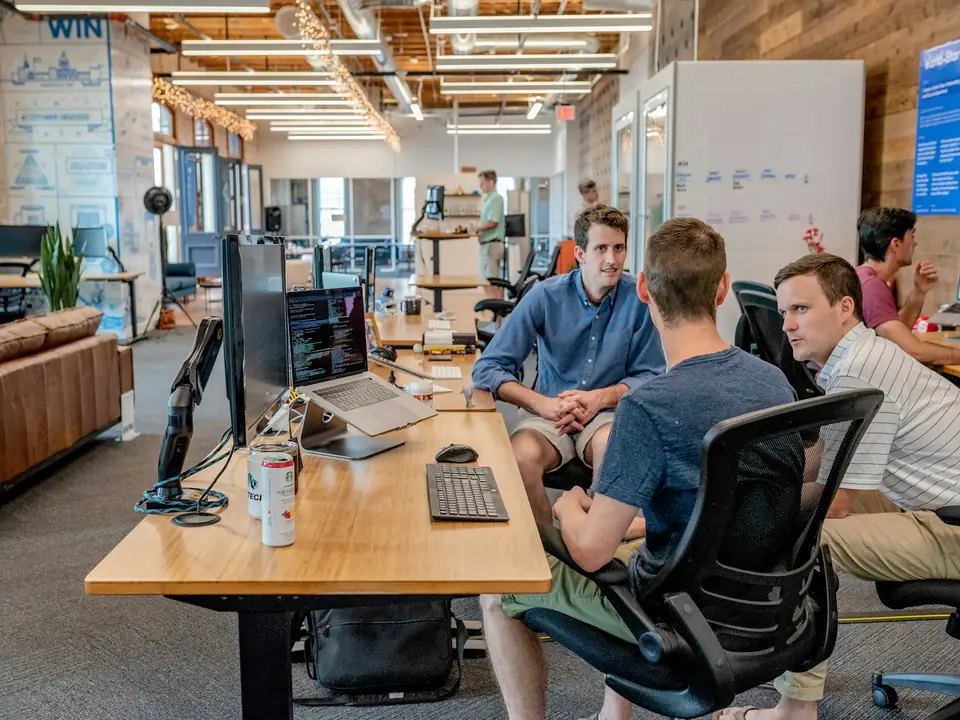
Hero photo: Abstrakt team members on our St. Louis campus. Abstrakt's own image.

Photos on this page: Vitaly Gariev (opens in a new tab) (Unsplash License (opens in a new tab)); Tim van der Kuip (opens in a new tab) (Unsplash License (opens in a new tab)); Austin Distel (opens in a new tab) (Unsplash License (opens in a new tab)).

Sales Talk newsletter

Get Sales Talk in your inbox

New playbooks, benchmarks and guides from our sales floor, for owners and sales leaders who sell to businesses. One email a month. See past issues.

Your email and the details you choose to add, nothing else. We never sell or share your address, and every issue has a one-click unsubscribe. Privacy Policy.

Schedule a MeetingCall (314) 338-8865