Agree that they should, then point to the part their team cannot do and why it matters.
The ENGAGE Sales Process
How we attack a sales call.
Every Abstrakt SDR runs the same framework on every call, built over 17 years and millions of conversations with decision-makers. It turns a cold dial into a qualified meeting: a real reason to talk, the right person on the line, honest answers to pushback, and a clear ask for the meeting.
Ask Ava anything about the information on this page.
A call, step by step
Eight steps from the dial to the meeting
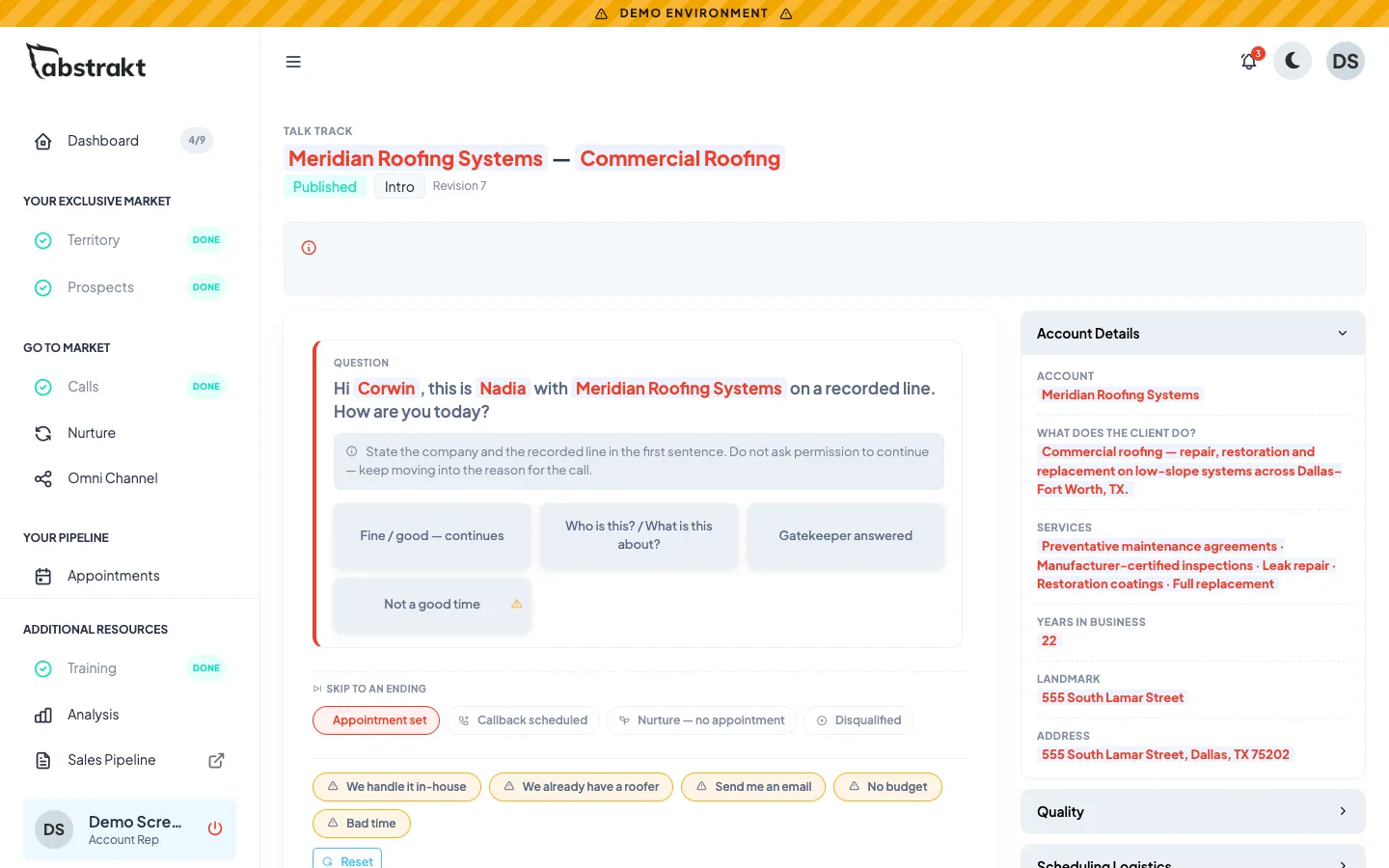
The lines below come from a sample commercial roofing talk track. Every program gets its own, written around your buyers.
-
Prepare before the dial
The SDR never dials blind. The dialer shows who they are calling, the title and direct line, why that person is the right contact, and what we already know about the account: facility data, past conversations and engagement on email and LinkedIn.
-
Open with honesty
A short, direct introduction: who we are, who we represent, and that the line is recorded. No tricks, no pretending to be someone else. It earns the next thirty seconds.
What it sounds likeHi {first name}, this is {rep} with {your company} on a recorded line. How are you today?
-
Get past the gatekeeper to the right person
When someone else answers, the SDR asks for the role that owns the decision rather than guessing at names, and turns "not available" into a callback time instead of a dead end.
What it sounds likeI'm trying to reach whoever handles roof maintenance for the building. Is that {name}?
-
Give a real reason for the call
The reason is specific to the prospect: their building, their market, what we know about their situation. A generic pitch gets a generic no. A specific reason gets a conversation.
What it sounds likeWe work on low-slope commercial roofs across {territory}, and your building came up at {square footage} with the roof last done in {year}. How are you handling maintenance and inspections right now?
-
Qualify while you talk
Two or three natural questions confirm the fit and who signs off: the qualifiers we agreed with you, the decision-making process and the timeline. Every qualifier is confirmed by the prospect, not assumed from a list.
What it sounds likeDoes the roof sit at about {square footage}, and are you the one who signs off on roof work, or does that go somewhere else?
-
Show why you are different
One clear differentiator or a result from a company like theirs. Not a feature list: the one thing that makes a meeting with you worth their time.
What it sounds likeWhat we do differently is the inspection itself. And the written report costs you nothing either way.
-
Handle pushback without arguing
Every talk track has a pushback guide for the objections we actually hear. The SDR acknowledges the concern (feel), shows others felt the same (felt), and shares what they found (found), then steers back to the meeting.
What it sounds likeGood, you should have someone. I'm not asking to replace them. Ours is a second opinion at no cost, and if they have everything handled it will say so.
-
Close for the meeting
A clear ask with two specific times, the reason to meet recapped, the calendar invite sent while the prospect is still on the line, and the right attendees added.
What it sounds likeLet's put it on the calendar. I have Tuesday at 10 or Thursday at 2. Which is better? I'll send the invite while we're on the line.
Hear the process
Pick your industry and hear a call
The same eight steps, run on a call in your industry. Each line is tagged with its step, so you can follow the process as it happens.
Dramatized example written from our talk tracks and voiced by AI. Names and figures are samples, not a recording of a real call. Grade it on our 5 Star Scorecard.
A talk track, not a script
The call follows what the prospect actually says
Our talk tracks are interactive. The SDR picks the answer they actually heard, and the track moves to the right next line: past a gatekeeper, into qualifying, or to the matching pushback answer and back. Nobody reads a wall of text, and every path is recorded.
Before an SDR dials your account, they train on it with an AI role play that raises pushback they have not seen, and they must pass a scorecard to be certified on your program.
The pushback guide
Answers ready for the objections we actually hear
Feel, felt, found: acknowledge the concern, show it is common, share what others found. Then steer back to the meeting.
Never ask them to fire anyone. Offer a second opinion that costs them nothing and either confirms their vendor or finds a gap.
Happy to, but tie the email to something only a meeting can produce, then offer two times.
Separate the meeting from the purchase: the first conversation costs nothing, and the decision comes later.
Ask for ninety seconds, or set a specific callback time rather than "call me later."
Every call ends somewhere
Four outcomes, all logged
- Appointment setA qualified meeting on your calendar, then graded on the 5 Star Scorecard before you see it.
- Callback scheduledA specific date and time to reach the right person, logged and kept.
- NurtureInterested but not yet: they move into nurture and stay in front of us until the timing is right.
- DisqualifiedNot a fit. They are removed from the list so they are not called again, and suppressed on every channel.
Every booked meeting is then graded before it reaches you. See the 5 Star Quality Process →
The ENGAGE sales process, answered
What is the ENGAGE sales process?
ENGAGE is the framework every Abstrakt SDR uses to run a call: prepare before the dial, open honestly, reach the right person, give a specific reason for the call, qualify while you talk, show what makes you different, handle pushback without arguing, and close for a meeting with two specific times.
Is it a script?
It is a talk track, not a script read word for word. The SDR follows the branch that matches what the prospect actually says, with prepared answers for the pushback we hear most, so every call sounds like a conversation.
Is the talk track built for my company?
Yes. Each program gets its own talk track: your reason for the call, your qualifiers, your differentiators and the objections your buyers raise. The SDR trains and is certified on it before dialing.
How do you know the calls are done right?
Every call is recorded. Every booked meeting is graded on the 5 Star Scorecard, which checks script adherence, appointment commitment and qualifiers before the meeting reaches you, and you can listen to the calls yourself.
More from Abstrakt
Every Abstrakt program
One company runs all of it, so the buyer hears the same story from the first call to the website, the sell sheet and the meeting.
- Outbound BDR A full BDR team for local or national selling
- Target list built for your trade and territory
- Phone, email, letters and LinkedIn run as one campaign
- Every meeting graded on a 25-point scorecard before it reaches you
- Every dial, email and recorded call in your Results Portal
- Enterprise SDR/BDR Fortune 1000 and complex, multi-stakeholder sales
- Account-based outbound into your target logos
- The buying committee mapped and multi-threaded
- Inbound lead qualification and trade show follow-up
- Market research calls before you launch
- SEO and AIEO Search Found on Google and cited in AI answers
- Website builds and hosting
- Local SEO and your Google Business Profile
- Ongoing content every month
- Technical SEO, social media and paid search
- Sales Collateral Video, sell sheets, case studies, decks, direct mail
- Sell sheets and one-page case studies
- Pitch decks and infographics
- Trade show materials
- Video and direct mail that match the call

Getting Ava ready…
AI video guide. Your voice is processed by Tavus to run this conversation; we never use your camera. Calls end after 5 minutes. Privacy