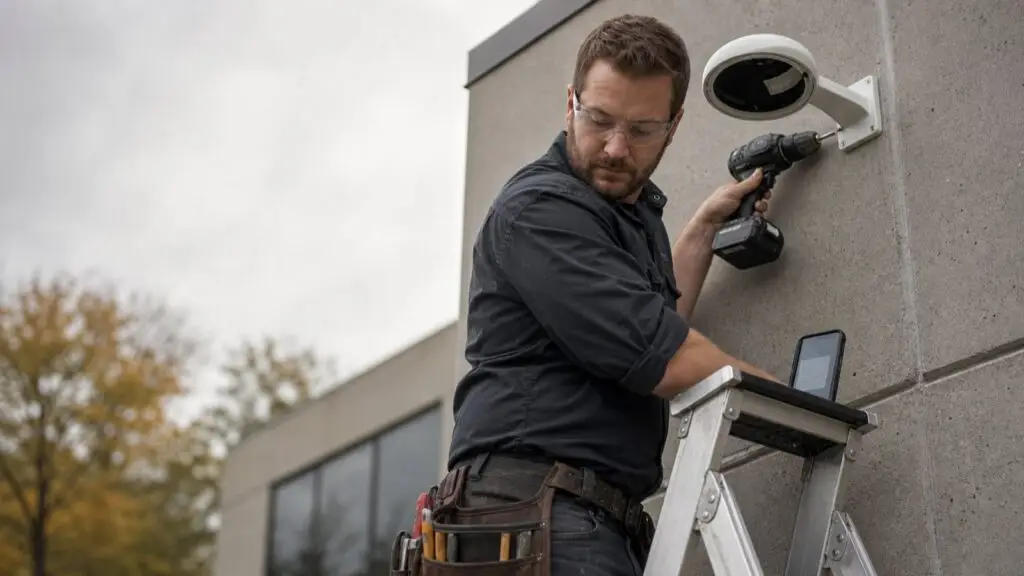
Four minutes of prep is the difference between a polite no and a booked commercial security site survey. Four boxes, filled in before you dial.
A commercial security integrator who calls a property manager cold, with nothing in front of them but a phone number, is going to sound like it. The call opens with a company name, drifts into a list of camera brands and access control platforms, and ends with “do you have any projects coming up.” The manager says no and goes back to work.
The difference between that call and one that books a commercial security site survey is usually not talent. It’s four minutes of prep before dialing. Enough to know what the building is, who uses it, how old the system in it probably is, and what one specific thing to name on the call. Not enough to overthink it.
In short
- A cold call to a property manager with nothing but a phone number sounds like it, and gets the polite no.
- Fill a four-box prep card per building: the map, tenants and age, the manager’s name, one thing to name.
- Property managers write next year’s budget on their own cycle, and the integrator who surveys while it’s open becomes the number in it.
Why four minutes and not forty
For a few weeks every year, property managers, facility managers, and directors of facilities are building the budget for next year. Security items are on it: the access control system that still runs on a server no one wants to touch, the analog cameras that were installed with the building, the lobby that needs credentials for a new tenant, the parking lot the tenants keep asking about, the monitoring contract that renews next quarter.
The integrator who surveys the building while that plan is open and hands the manager a range becomes the number in it. The plan goes up to ownership a month or two later, gets approved before the new year starts, and the work goes out to bid a few months after that, against that number. Fiscal years vary from one owner to the next, so ask which one the building is on.
So the calls matter, and there are a lot of them to make. Forty minutes of research per building means three calls a day. Four minutes means twenty. The prep has to give you exactly what the opening needs: one true thing about their building and one question about their calendar.
The four-minute routine before a commercial security site survey call
01
The building on the map
Count the entrances. Find the loading dock and where trucks stage. Look at the parking: one lot or three, surface or structure, a gate or an open curb cut. Every one of those is a door, a camera, or a reader in someone’s future plan.
02
The tenant mix and the age
A single-tenant warehouse, a multi-tenant office with a shared lobby, a medical building with after-hours traffic, and a mixed-use property with ground-floor retail are four different conversations. Then the year built from county records.
03
The manager’s name and title
A name, not “property management.” Single building: the property manager or facility manager. Portfolio or campus: the director of facilities or regional property manager. Owner-occupied: sometimes the operations manager.
04
The one thing to name
Pick one specific thing from the first two boxes and put it in a question about their calendar. Write it down. Say it out loud once. Then dial.
“With next year’s budget being put together, is the rear entrance off the loading dock on your list?” Or: “You have a multi-tenant lobby and I didn’t see coverage on the north lot from the street. Has access control or the parking come up for next year?”
A 1990s building with no visible upgrades is probably running the system that came with it. A 2018 building has a system coming up on its first refresh. Either one gives you a sentence that’s true and specific, which is the whole point of the four minutes.
Before the plans go up
Abstrakt sets appointments with the property managers and facility managers planning commercial security work, so your team spends its week walking buildings instead of dialing. The site survey, the number, and the job are yours.
What the prep does to the commercial security site survey call
No prep
- Opens with a company name
- Lists camera brands and platforms
- “Any projects coming up?”
- Polite no
Four minutes of prep
- Opens with their building
- Names one thing you actually saw
- Asks about the plan they’re writing
- Books the survey
Then you offer the survey itself: an hour walking the entrances, the lot, the head-end room, and the lobby, a one-page summary of what you saw, and a rough range for the two or three items that belong in the budget. No proposal. You want to be the source of their number.
Security work is layered by nature, which is why it sits well in a budget. CISA puts it plainly: there are “preventative and protective strategies that can be implemented at all levels.” A survey that names those layers gives the manager a list they can phase over two budget years instead of one number they have to fight for all at once.
If the answer is “the system is fine,” you still have the entrances, the tenants, the age, and a name for next year’s list. Those four minutes still earned their keep.
See it in your market
Security company lead generation covers who we call, what a set appointment looks like, and what you keep. Or take the cold calling best practices guide with you.
What to do this week
Print the prep card. One per building, four boxes, filled in before every call, no exceptions.
Batch the prep. Twenty cards in the morning, twenty calls in the afternoon. Switching between the map and the phone is slower than it sounds.
Keep the cards. A filled-in card for a building that said no this year is most of the prep already done for the same building next year.
Time yourself. If a card is taking ten minutes, you’re researching things the opening doesn’t need. Map, tenants and age, name, one thing. That’s the whole list.
What four minutes won’t do
Four minutes of prep doesn’t make a manager need a system they don’t need. Some buildings were done last year, some managers have an integrator they trust, and some won’t pick up. What the prep does is make sure that when a manager picks up, the first thing they hear is somebody who knows their building instead of somebody reading a product list.
Four boxes, four minutes, then the call. That’s the whole routine, and it’s the cheapest way to turn a list of buildings into a commercial security site survey on the calendar.
Frequently Asked Questions
What is a commercial security site survey?
A site survey is about an hour walking the entrances, the lot, the head-end room, and the lobby with the property manager. It ends with a one-page summary and a rough range for the items that belong in the budget, not a proposal.
What should a security integrator research before cold calling a property manager?
Four things, in about four minutes: the building on the map (entrances, dock, parking), the likely tenant mix and year built, the manager’s name and title, and one specific item to raise as a question about next year’s budget.
When do property managers plan commercial security upgrades?
Roughly a quarter before their fiscal year turns over. The budget gets built, goes up to ownership a month or two later, and is approved shortly before the new year starts. Access control, cameras, and monitoring renewals go on that list, so a survey done while the plan is open is what shapes the number. Fiscal years vary, so ask which one the building runs on.
How do you tell how old a building’s security system is before you walk it?
Year built from county records is the strongest single signal. A 1990s building with no visible upgrades is usually running close to its original system. Street view adds detail: analog camera housings, a surface-mounted reader, or no reader at all on a side entrance.
Who owns the security budget in a commercial building?
It depends on the property. A single building usually sits with the property manager or facility manager, a portfolio or campus with the director of facilities, and an owner-occupied site sometimes with the operations manager. Ask the front desk who handles the budget.
Should an integrator quote a price on the first call?
No. Offer the survey and a range afterward. A price before anyone has seen the head-end room invites comparison shopping on incomplete information. A range tied to a written scope of doors, readers, and camera counts is what a property manager can defend to ownership.
Keep going
- Security company lead generation
- What to say when you cold call a facility manager
- Outsourced SDR services
- Cold calling services
- How to write a cold call script
- How to get commercial landscaping contracts
About this article
Jeff Winters is Chief Executive Officer at Abstrakt. Reviewed by Neil Erker, Chief Marketing Officer. Abstrakt sets appointments for commercial security integrators and the wider trades, and the patterns here come from that calling.

Abstrakt is a technology-enabled outsourced sales development company that books 100,000+ meetings a year for 1,500+ clients.
More on security
Learn how appointment setting for security services drives qualified sales meetings using SDRs, CRM syncing, and lead qualification.

Discover lead generation strategies for security companies. Learn how to use SEO, PPC, email campaigns, and cold calls to get more clients.

Discover how PPC for security companies can drive ROI. Learn how targeted Google and social ads attract high-value commercial clients.

Getting Ava ready…
AI video guide. Your voice is processed by Tavus to run this conversation; we never use your camera. Calls end after 5 minutes. Privacy