A parking lot checklist is worth more to a property manager than a bid. A bid asks for money. A checklist tells them what they own and what it’s about to cost.
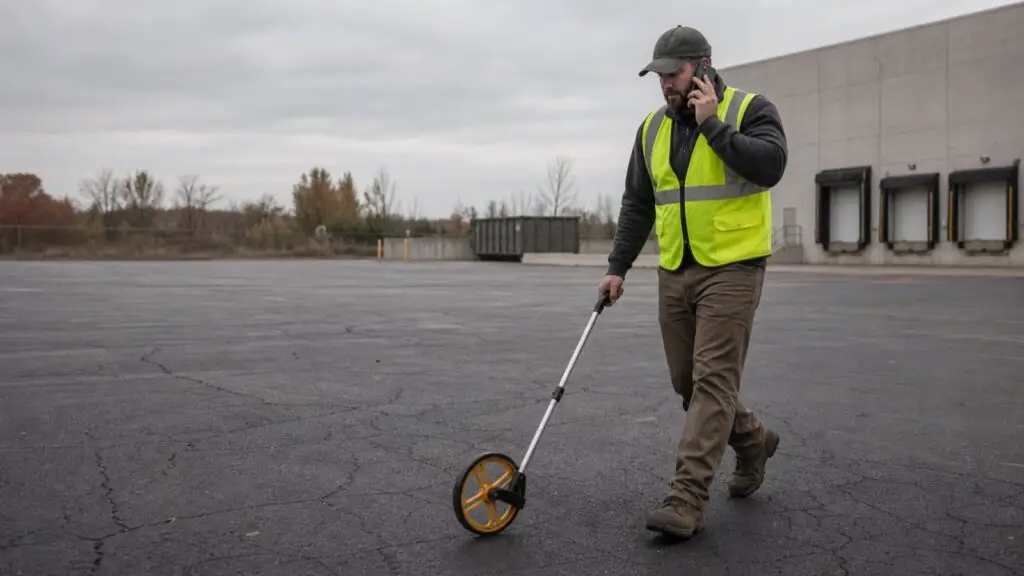
Most paving contractors show up with a price. The ones who get called back show up with a checklist, walk the lot alongside the manager, and leave a written picture of the surface behind. The price comes later, and by then it has context.
A lot the manager can’t describe is a risk sitting on their property. A lot with a written condition summary is a line they can defend to an owner. Those are very different things, and only one of them gets funded.
In short
- Ten things to look at, each with a plain finding and a consequence.
- Cracking pattern tells you whether the problem is the surface or the base. Get that wrong and the repair fails.
- There’s a published standard for scoring pavement condition, and property managers who deal with public agencies already know it.
- Rank findings as safety, structural, or cosmetic. That ranking is what turns a walk into a budget line.
The ten-point walk
Print this. Walk the lot with the property manager, not ahead of them, and write the finding in their words as well as yours.
| Look at | What you’re recording | What it usually means |
|---|---|---|
| 1. Cracking pattern | Straight lines, or interconnected blocks the size of a hand | Straight is surface. Interconnected is the base moving |
| 2. Standing water | Where it sits, and how long after rain | Water reaching the base is what turns cracks into holes |
| 3. Potholes | Count, depth, and whether they repeat in the same spots | Repeat locations mean the base failed, not the patch |
| 4. Edges and curb line | Raveling, drop-off, separation from the curb | Where water gets underneath. Cheap now, structural later |
| 5. Drainage structures | Grate condition, silt level, settlement around the rim | A silted basin is the cause of several other rows |
| 6. Oil and fuel staining | Size and location, usually loading areas and drive lanes | Softens asphalt. Sealer won’t bond over it |
| 7. Striping and markings | Legibility, and whether stalls still match the layout | The cheapest visible improvement a manager can approve |
| 8. Accessible parking | Signage, access aisles, surface condition at those stalls | A compliance question, not a cosmetic one |
| 9. Trip hazards | Vertical separation at joints, patches, and walkway edges | The row that moves fastest through an approval process |
| 10. Traffic and loading | Where trucks turn, stage, and sit still | Explains why one corner fails while the rest holds up |
Read the cracks before you price anything
Row one carries more weight than the other nine combined, because it decides what kind of job this is.
Straight cracks running in one direction are usually a surface problem. They can be cleaned and filled, and sealer does useful work afterwards.
Interconnected cracking, the kind that breaks the surface into rough blocks, means the base underneath is moving. Sealing over it hides the symptom for one season and changes nothing. The pattern is telling you the repair has to go deeper, and a contractor who seals it anyway has taken money for something that was always going to fail.
“See how these connect into blocks? That’s the base moving, not the surface. Sealing it would look better for a season and cost you the same job again next year.”
Saying that out loud, on the lot, while declining to sell the cheaper thing, does more for a paving contractor’s credibility than a decade of brochures. Managers remember it.
There’s a published way to score this
Property managers who work with municipalities, school districts or anything federally funded have usually met this already, and most paving contractors never mention it.
ASTM D6433 is the Standard Practice for Roads and Parking Lots Pavement Condition Index Surveys. It defines the Pavement Condition Index, a numerical rating of surface condition derived from a visual survey of the distresses actually present. Pima County, which publishes its own road scores, states that PCI “ranges from 0 to 100 with the latter representing new pavement.”
The standard is direct about what the index is for. It says the PCI “provides an objective and rational basis for determining maintenance and repair needs and priorities,” and that continuous monitoring “is used to establish the rate of pavement deterioration, which permits early identification of major rehabilitation needs.”
Read that as a paving contractor and it’s an argument for the recurring assessment, written by a standards body. It also says plainly what the index can’t do: it “can’t measure structural capacity, nor does it provide direct measurement of skid resistance or roughness.” The index was developed by the U.S. Army Corps of Engineers and has been adopted by the Department of Defense and the American Public Works Association.
You don’t need to run a formal survey to use any of this. Naming the standard tells a property manager that pavement condition is a measured thing with a method behind it, and that you know the method. That alone separates you from the contractor who said the lot looks rough.
More lots to walk
Abstrakt sets appointments with the property managers, facility managers, and owners who approve pavement spending, so your estimators are walking lots instead of driving them looking for cracks. The walk, the number, the proposal, and the contract are yours.
Rank the findings or they won’t get funded
Ten observations handed over unsorted is a problem the manager now owns. Ranked, the same ten become a plan they can take upstairs.
Safety
Trip hazards, accessible parking, anything a person could fall on. Moves fastest, needs least justification, and is usually small money.
Structural
Base failures, drainage, edges letting water underneath. Expensive to defer and the number grows while it waits.
Cosmetic
Striping, staining, appearance. Easy to approve, easy to delay, and genuinely useful when a building is being marketed.
Put a range against each group, not a single total. A manager needs to be able to fund one group this year and carry the others, and a single lump sum forces an all-or-nothing answer that’s usually nothing.
Getting the walk in the first place
None of this works from the street. The whole method depends on being on the property with the person who controls the budget, which is the part most contractors treat as luck.
Ask for the walk directly, and make the checklist the reason.
“I’m not quoting anything today. Give me twenty minutes on the lot and I’ll leave you a written condition summary you can put in your plan, whether or not you ever use us.”
Then honor it. Leave the page even when there’s no work in it for you this year, because the manager keeps that page, and pavement doesn’t improve on its own.
Frequently Asked Questions
What should be on a parking lot maintenance checklist?
Cracking pattern, standing water, potholes, edges and curb line, drainage structures, oil staining, striping, accessible parking, trip hazards, and where trucks turn and sit. Ten rows, each with the finding and what it means, so the page is readable by somebody who wasn’t on the walk.
What does interconnected cracking mean?
The base is moving. Straight cracks are usually a surface problem, and they can be cleaned, filled and sealed with sealer doing genuinely useful work afterwards. Cracking that connects into rough blocks is different. The failure is underneath, and sealing over it buys a season.
Is there a standard for rating parking lot condition?
Yes. ASTM D6433, Standard Practice for Roads and Parking Lots Pavement Condition Index Surveys, defines the PCI from a visual survey of observed distresses. The standard says it gives an objective and rational basis for determining maintenance and repair needs and priorities, and notes it can’t measure structural capacity or directly measure skid resistance or roughness. The index was developed by the U.S. Army Corps of Engineers.
Why does standing water matter on asphalt?
Because water that reaches the base is what turns a crack into a pothole. Surface water drains. Water that sits is finding its way underneath, and once it does, everything below the surface gets weaker until the patch stops holding.
How should findings be presented to a property manager?
Grouped as safety, structural and cosmetic, with a range against each group instead of one total. Safety clears approval quickly and costs little. Structural grows more expensive while it waits. Cosmetic is easy to defer. A manager who can fund one group this year will usually come back for the others, whereas a single lump sum forces an all-or-nothing answer that’s generally nothing.
Should you walk a lot even if there’s no work in it?
Yes. The page stays in the property file with your name on it, and pavement doesn’t repair itself. The contractor who left a useful summary and asked for nothing is the one who gets called when the budget finally exists. That call comes.
Keep going
- Commercial paving lead generation
- What to ask before you price a commercial landscaping bid
- What to say when you cold call a facility manager
- Outsourced SDR services
- Cold calling services
About this article
Jeff Winters is Chief Executive Officer at Abstrakt. Reviewed by Neil Erker, Chief Marketing Officer. Abstrakt sets appointments for commercial paving contractors and the rest of the trades, and the questions here come from that calling.

Abstrakt is a technology-enabled outsourced sales development company that books 100,000+ meetings a year for 1,500+ clients.